This article was written by W. Scott Bailey for the San Antonio Business Journal
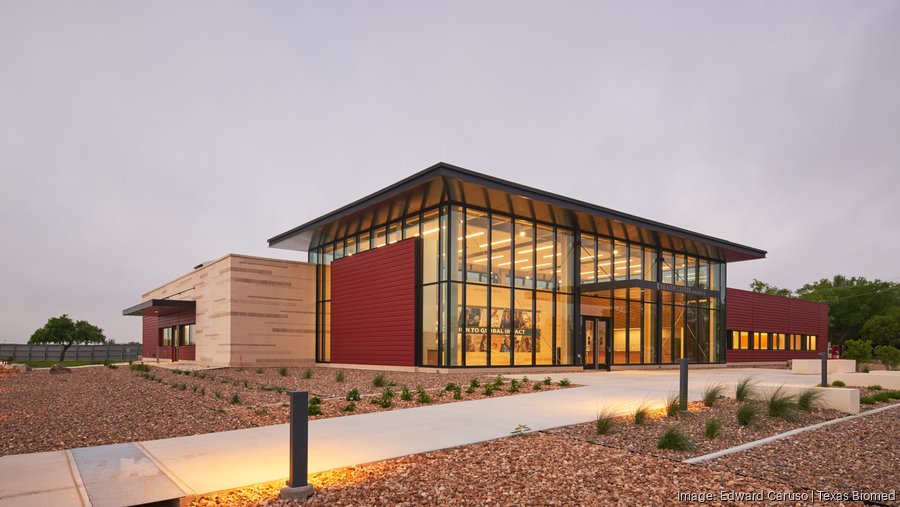
A new $20 million center will serve as a hub for next generation research on the 200-acre campus.
- Texas Biomedical Research Institute completed a $20 million Health Center.
- The 18,000-square-foot facility anchors a $210 million campus expansion plan.
- The center supports research for the Southwest National Primate Research Center.

Texas Biomedical Research Institute has taken a big step toward its major campus expansion, completing work on a new Health Center expected to boost its efforts to accelerate next-generation science addressing critical global health challenges.
The 18,000-square-foot Health Center, a $20 million project, will house biomedical labs, as well as pathology and histology services, among other functions. It will also serve as a hub for collaborative research as part of the 200-acre institute’s Southwest National Primate Research Center, one of seven such federally designated facilities funded in part by the National Institutes of Health.
I reported last spring that Texas Biomed, which has played a critical role in combating numerous global health threats including Covid-19, was embarking on a roughly $210 million plan to expand the 200-acre campus’ footprint and capabilities. That plan is also expected to strengthen the Alamo City institute’s position as a global leader in infectious disease research and to enhance its access to the more than $16 billion biodefense market.
“It’s absolutely key that we look at every way to diversify our investments, to modernize our campus,” Texas Biomed President and CEO Dr. Larry Schlesinger told me. “The demand is enormous.”

The new center will boost Texas Biomed’s work with the National Institutes of Health, Biomedical Advanced Research and Development Authority, the Department of Defense, university researchers and pharmaceutical and biotechnology industry clients.
Completion of the new center comes as Texas Biomed has continued to add more scientific talent. It will help anchor a new 70,000-square-foot complex that will enable scientists at Texas Biomed and the SNPRC, as well as other researchers, to further study infectious and related chronic diseases.
“This new center provides access to the latest technologies, helping us answer some of the biggest questions in human health, including infectious diseases, obesity, aging, and neurodegenerative conditions like Alzheimer’s and Parkinson’s disease,” SNPRC Director Corinna Ross said.
This latest investment comes at a crucial moment, according to Texas Biomed officials, as global demand for infectious and chronic disease research continues to escalate.
“The opening of the Health Center represents a major milestone for the Institute,” Texas Biomed Chairman Craig Boyan said.