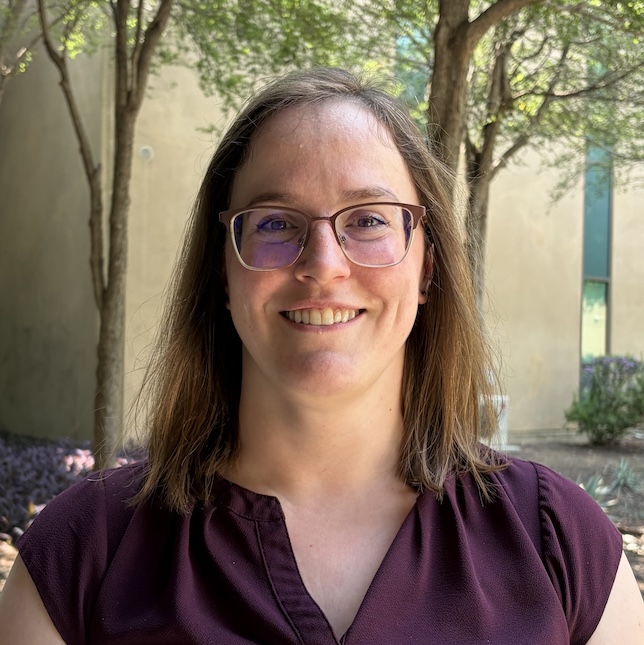
(June 3, 2026) — Emily Speranza, Ph.D., first heard about Ebola virus when she was five years old.
“I remember hearing about it on the news and little me thought ‘This is terrifying. I need to know everything about it so I am not so scared,’” she said. “In that process, I realized ‘Wow! These viruses are actually kind of cool.’”
Deadly pathogens have held her attention ever since. Now a recognized expert in Ebola and related filoviruses, bioinformatics and immunology, Dr. Speranza is joining Texas Biomedical Research Institute as an Assistant Professor. She will split her time between her ongoing research and overseeing biosafety level 4 (BSL-4) studies for partners working with Texas Biomed’s Applied Science and Innovation unit.
“Dr. Speranza’s advanced bioinformatics skills and experience in high containment research will be an excellent complement to our team and help us expand potential collaborations, particularly in analyzing immune responses to new drugs or therapies,” said Lee-Ann Allen, Ph.D., Texas Biomed Executive Vice President, Research.
Innate immune responses
Dr. Speranza’s research focuses on the very first immune responses occurring in a human or animal in the first days after exposure to a severe pathogen like Ebola virus.
“We want to understand how fast can the virus replicate versus how fast can the host respond,” she said. “How can we potentially leverage that information to give the host a bit of an edge?”
She uses a combination of techniques to build a very detailed view of the interaction between the pathogen and host, including animal models, single cell sequencing, high-plex flow cytometry, bioinformatics and machine learning.
“When the virus gets in, it’s not just interacting with a single cell, it’s in a very complex environment,” she said. “We’re trying to profile as much of that infection environment as possible in order to try to find pathways that maybe wouldn’t be detected if we were focusing in just on one or two cell types.”
Computers help parse through the massive data sets to help flag those pathways that could then potentially be targeted by drugs or therapies to help the human or animal fight off the pathogen.
An accidental math major
Dr. Speranza attended Carroll College in her hometown of Helena, Montana to pursue biology. As she completed the required math courses, a professor noticed how easily she handled the material and suggested more advanced classes to fill her schedule. This continued until Dr. Speranza realized she had taken all but two needed for a math degree, so she dual majored.
For her Ph.D., she studied bioinformatics at Boston University, which allows her to “combine my passion for biology and deadly pathogens with my math brain.” She also narrowed in on infectious diseases and high containment research. Along with Ebola virus, she has worked with Crimean-Congo hemorrhagic fever virus, Chikungunya virus, Zika virus and Francisella tularensis, which is a bacterium that causes tularemia, which can be lethal without treatment.
“I fell in love with the field of these emerging pathogens,” she said. “You’re always on the cutting edge because there’s not a lot that we know about them. Some of them are just understudied. Some of them are new.”
She completed a postdoctoral fellowship that allowed her to work with researchers at both the National Institute of Allergy and Infectious Diseases (NIAID) main campus in Maryland and at the BSL-4 at Rocky Mountain Laboratories. She became an NIAID independent research scholar before joining the Cleveland Clinic’s Florida Research Innovation Center. As part of her research, she has worked with specialized mouse models to study specific immune response pathways, such as the Mitochondrial Antiviral-Signaling Protein (MAVS), to better understand what immune responses are protective versus promote harmful inflammation.
Deep spatial proteomics
Dr. Speranza helped develop a method to gather extremely detailed information about protein activity during infection, particularly in BSL-3 and BSL-4 labs, which require specialized protocols for safety. The method, called Opal-Plex, is part of the iterative bleaching extends multiplexity (IBEX) protocols and allows for deep spatial proteomics – instead of identifying what one or two proteins in a physical tissue sample are doing at a precise location at a specific moment during infection, researchers can observe up to 25 proteins in one sample from a BSL-4, and more than 70 from samples originating in BSL-2 labs.
By gleaning more information from one tissue, Dr. Speranza is building a fuller picture of infection dynamics.
“We’re applying the same concepts for analyzing tumor micro-environments, but for infection,” she said. “What is going on in the infection micro-environment, and how can we then potentially modulate it to give the host an advantage during an infection?”
She now brings this expertise to Texas Biomed, which attracted her with its unique combination of high containment labs, the Southwest National Primate Research Center and the clear synergy with other faculty on campus.
“I am really excited about the people here, where emerging pathogens is on the forefront of everyone’s minds,” she said.